
ABSTRACT
This article examines the life of Shri Ram as a paradigm of ethical governance, Rajdharma, and constitutional morality. It argues that his decisions—particularly relinquishing the throne of Ayodhya and separating from Sita- reflect a higher commitment to moral legitimacy over personal entitlement. Drawing parallels with modern legal doctrines such as parens patriae and principles akin to responsibility, promissory estoppel, the article situates Ram’s conduct within the framework of public duty and collective welfare. Judicial references, including S.R. Bommai v. Union of India and Charan Lal Sahu v. Union of India, underscore the importance of public trust and state guardianship. It further cautions against reductive interpretations of his actions, advocating a contextual reading aligned with the Historical School of Law and evolving constitutional standards, as seen in Navtej Singh Johar. Ultimately, Ram’s journey symbolizes the enduring ideals of justice, sacrifice, and righteous leadership.
INTRODUCTION: RAM’S LIFE- BEYOND THEOLOGY
Hello patrons and our beloved community members! On this virtuous occasion of Shri Ram Navami, we extend our heartfelt wishes to you all. Shri Ram’s life embodies unwavering Dharma (Righteousness), moral courage, and selfless leadership, offering a timeless template for Rajdharma and constitutional-style guardianship of the people.
The life of Shri Ram, as narrated in the Ramayana, is not merely a theological account but a profound study in ethical governance, duty, and constitutional morality. His conduct in moments of intense personal adversity reflects virtues that resonate deeply with modern principles of public law in India—particularly the contemporary doctrine of parens patriae and time- tested tenets of Rajdharma.
RELINQUISHING THE THRONE: PROMISSORY ESTOPPEL BEYOND PRIVITY
One of the most striking aspects of Shri Ram’s life is his willingness to relinquish his rightful claim to the throne of Ayodhya in fulfilment of his father’s promise. This should not be seen in a myopic vision of obedience to his father’s word but should be acknowledged, if not revered, as an act of keeping father’s promise. This grand gesture surpasses the mandates of modern-day jurisprudence, where obligations of promissory estoppel are subject to privity of the concerned parties. Ram’s conduct sets lofty ideals of the contract law mandate, where he undertakes to fulfill the promises made by his father and not him in particular. From a legal standpoint, this act may appear as a surrender of a legitimate entitlement; yet, it embodies the higher principle that authority is sustained not merely by legality but by moral legitimacy.
PARENS PATRIAE: GUARDIANSHIP OVER KINSHIP
Equally significant is his painful decision to part ways with beloved wife Sita in response to public sentiment. While modern and woke sensibilities may critique this act, it must be contextualized within the framework of contemporary Rajdharma—the duty of a ruler to prioritize public confidence over private inclinations. In S.R. Bommai v. Union of India (1994), the Supreme Court emphasized that governance must uphold constitutional morality and public trust. Shri Ram’s actions illustrate that a true people’s leader does not evade difficult decisions merely because they attract criticism; rather, he accepts the burden of judgment in the larger interest of societal order.
This principle closely parallels the doctrine of parens patriae, under which the State acts as the guardian of its people. Indian courts have invoked this doctrine in cases such as Charan Lal Sahu v. Union of India (1990), particularly in contexts where the State must act in the best interests of its citizens, even when such actions may conflict with individual preferences. Shri Ram’s life demonstrates that leadership entails a constant balancing act between personal emotions and collective welfare. His choices were not a denial of human attachment but an affirmation that public duty, once assumed, demands a higher standard of self-restraint.
It is, however, essential to approach these narratives with interpretive care. Reducing Shri Ram’s decisions to simplistic labels—whether of patriarchy or insensitivity—risks a myopic understanding of a complex ethical framework. His actions must be examined within the socio-legal context of his time, a principal which forms the edifice of the jurisprudence of Historical school of Law where the collective consciousness and the spirit (Geist) of the people (Volk) constitute the prevailing social order and consequently the law (Volkgiest). Much like how constitutional interpretation today is guided by evolving standards, as seen in Navtej Singh Johar v. Union of India (2018), where the Court emphasized a contextual and purposive reading of norms.
CONCLUSION
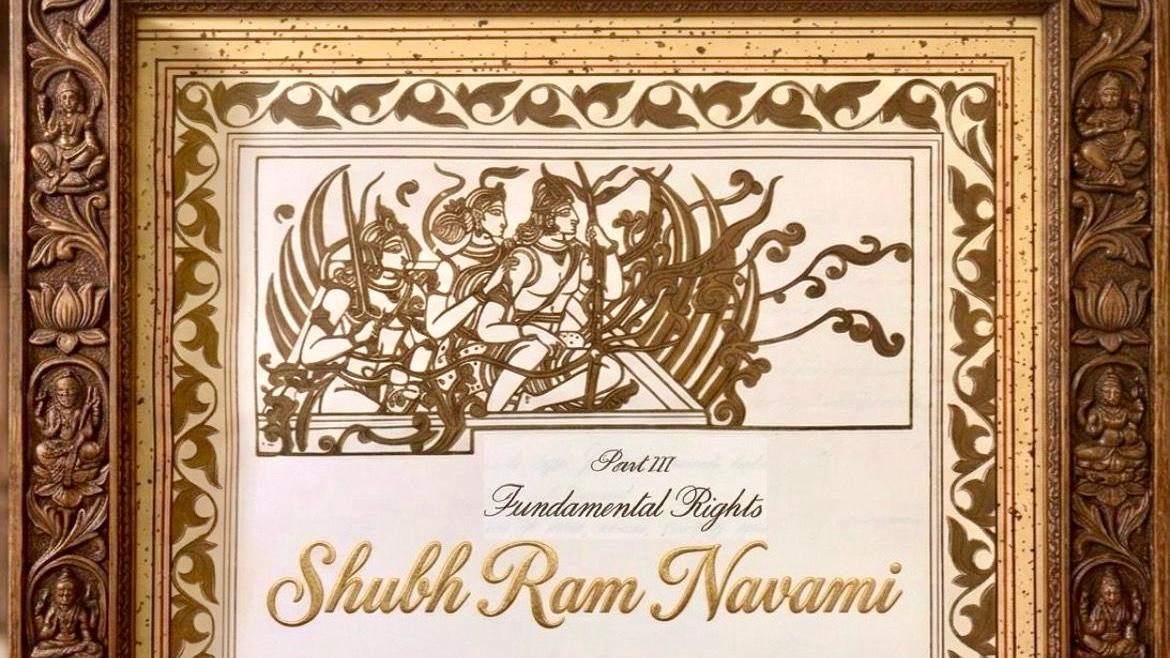
Finally, the culmination of Shri Ram’s journey—his victory in Lanka and return to Ayodhya—symbolizes the triumph of righteousness and the restoration of a just order. This imagery finds a subtle yet profound reflection in the original draft of the Constitution of India, where illustrations accompanying Part III (Fundamental Rights) include depictions of Ram, Lakshman, and Sita returning to Ayodhya on the Pushpak Viman. This artistic inclusion is not incidental; it signifies that the idea of justice in India is deeply rooted in a civilizational ethos that values duty, sacrifice, and moral governance.
In sum, Shri Ram’s life offers a timeless template for leadership anchored in Rajdharma—where personal sacrifice is not a weakness but the very foundation of legitimate authority.
– Team ADVOKIT
Tags:
You May Also Like

-
May 10, 2026
ABSTRACT: The persistent conflict between hate speech and freedom of speech is not new. Freedom of speech is the cornerstone of...

-
Mar 17, 2026
Most Law Students Want to Work in Corporate Law. But Very Few Know What Corporate Lawyers Actually Do. Every year,...

-
Mar 16, 2026
I first heard the Latin phrase “volenti non fit injuria” in my Tort Law class, and honestly, it sounded intimidating....

-
Mar 5, 2026
The transaction from the Indian Penal Code (IPC), 1860, to the Bharatiya Nyaya Sanhita (BNS), 2023, has been a landmark...
Get in touch
Call us
+91 7309 606 226
info@advokit.co.in
Address
1, Sapru Marg, 2nd floor above Mr Brown, Hazratganj, Lucknow, Uttar Pradesh - 226001