
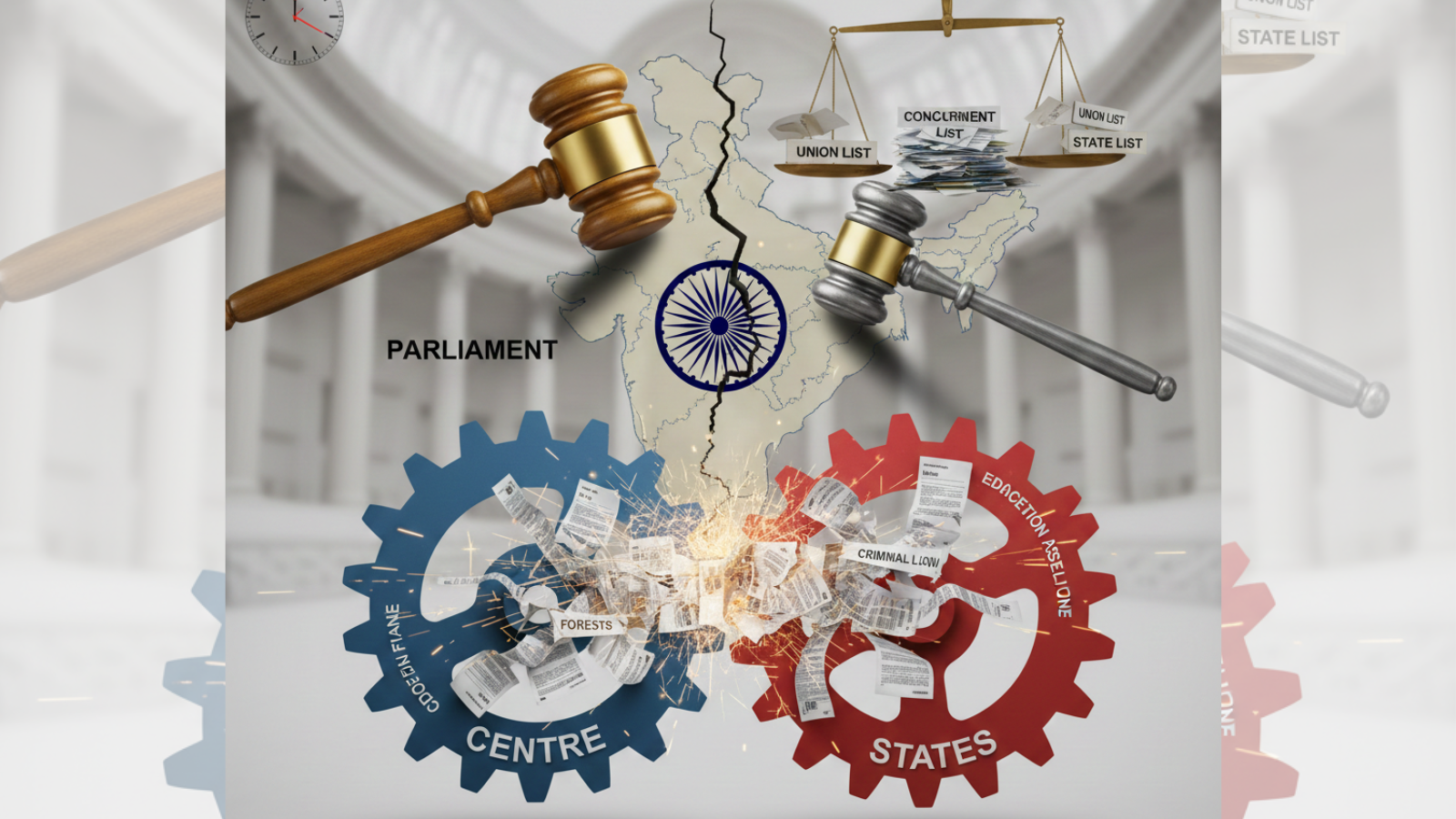
The Indian Constitution is an impressive example of federal government. It was designed to strike a compromise between two seemingly incompatible objectives: maintaining the integrity of a large and diverse country while granting considerable autonomy to different areas. Although this delicate equilibrium has persisted for many years, the federal system seems to be under increasing pressure in recent years. The growing dispute between the Center and the states over topics included by the Concurrent List is at the core of this friction and is becoming more apparent.
Understanding the Spirit of Indian Federalism
India adopted what Dr. B.R. Ambedkar called a “Union of States,” rather than a federation of equal and independent parts, in contrast to the traditional kinds of federalism found in nations like the United States or Australia. The desire to preserve a powerful central government while allowing states sufficient autonomy to handle local matters is reflected in the wording itself. The Seventh Schedule of the Constitution, which separates topics into three groups—the Union List, the State List, and the Concurrent List—clearly outlines the distribution of authorities.
While the State List permits autonomy in sectors like police, health, and agriculture, while the Union List addresses issues of national concern like defense, foreign policy, and currency, the Concurrent List occupies a difficult middle ground. It covers topics including education, forestry, marriage laws, criminal procedure, and trade unions where both the federal government and the states have the authority to enact legislation. This overlap was intended by the Constitution’s founders to promote harmony and collaboration. However, it has gradually turned into a platform for constitutional and political tug-of-war throughout the years.
The Constitutional Framework: Power and Precedence
A vital process for settling disputes that emerge in the Concurrent List is provided under Article 254 of the Constitution. It stipulates that the central law takes precedence to the degree of repugnancy between a state law and a central law on the same issue. However, unless Parliament later overrides it with fresh legislation, a state law that has been approved by the President may take effect in that specific state.
Although this article’s goal was to maintain national coherence on important matters, it has progressively shifted the balance of power in favour of the Center. Cooperative federalism has evolved into what many observers today refer to as centralized federalism due to the growing predominance of federal law on related issues, frequently without sufficient state input.
Case Studies of Growing Strain
Over the past ten years, a number of legislative disputes have revealed the pressure on India’s federal compact. The 2020 farm regulations, which aimed to liberalize agricultural markets throughout India, are among the most well-known instances. In the Concurrent List, agriculture overlaps with trade and commerce even though it is essentially a state subject. Many states claimed that the Center had invaded their constitutional rights by directly regulating agricultural products and market systems. These rules were subsequently repealed due to opposition from state governments and farmer organizations, but the incident left a strong sense of institutional mistrust.
Education has been another point of disagreement. Several states expressed unease with the Center’s attempt to impose uniform models of curriculum and language policy with the introduction of the National Education Policy (NEP) 2020, contending that education should maintain a strong regional character reflecting local linguistic and cultural contexts. Similar concerns have been voiced that states are being considered as simple implementers of centrally planned schemes rather than as partners in policymaking, despite the fact that recent changes to labor standards, environmental legislation, and forest management regulations fall within Parliament’s purview.
Judicial Role and the Need for Balance
The Supreme Court has repeatedly emphasized that federalism forms part of the Constitution’s basic structure, most notably in S.R. Bommai v. Union of India (1994). Yet courts can only intervene after conflicts arise. Real balance depends on institutional dialogue before disputes reach that stage. Revitalizing the Inter-State Council and promoting greater consultation through bodies like the Finance Commission and NITI Aayog could prevent future deadlocks.
The Road Ahead: Reviving Cooperative Federalism
Both levels of government must cooperate rather than compete in order for federalism to succeed. Fiscal devolution must coexist with legislative collaboration, and the Center should engage states more transparently before enacting laws on related topics. Instead of imposing uniformity from above, true federal strength is found in allowing states to innovate within national aims.
Conclusion
India’s federal system has survived because it uses communication to accommodate difference. However, that equilibrium starts to deteriorate as central dominance increases unchecked. Mutual respect, trust, and ongoing consultation are necessary to preserve the spirit of cooperative federalism. The Union is strengthened by strong states, a concept that is just as important now as it was when the Constitution was first ratified.
You May Also Like

-
May 10, 2026
ABSTRACT: The persistent conflict between hate speech and freedom of speech is not new. Freedom of speech is the cornerstone of...

-
Mar 27, 2026
ABSTRACT This article examines the life of Shri Ram as a paradigm of ethical governance, Rajdharma, and constitutional morality. It...

-
Mar 17, 2026
Most Law Students Want to Work in Corporate Law. But Very Few Know What Corporate Lawyers Actually Do. Every year,...

-
Mar 16, 2026
I first heard the Latin phrase “volenti non fit injuria” in my Tort Law class, and honestly, it sounded intimidating....
Get in touch
Call us
+91 7309 606 226
info@advokit.co.in
Address
1, Sapru Marg, 2nd floor above Mr Brown, Hazratganj, Lucknow, Uttar Pradesh - 226001