
FIR Registration Fight: 7 Police Station Mistakes Fresh Advocates Always Make
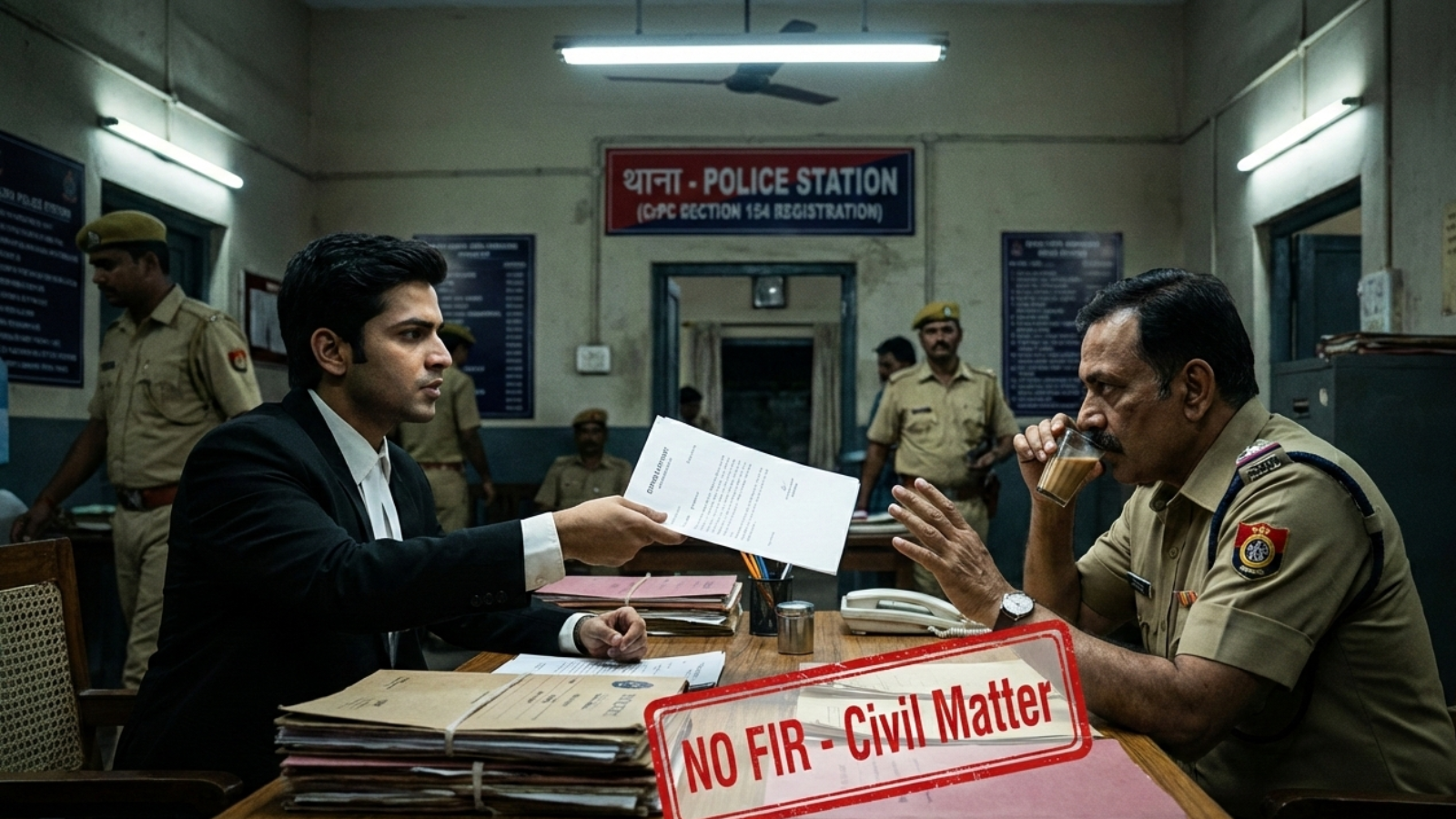
Imagine a young attorney entering a busy police station at ten o’clock at night with a brief in hand. After listening to the complaint recital, the SHO looks up from his chai and dismisses it with a casual “Civil matter.” No FIR. The rookie becomes enraged, makes threats of writs, and leaves empty-handed once more. FIR registration battles are the harsh rite of passage when CrPC Section 154 meets everyday life for new advocates in India.
Why do police resist, and why do rookies always lose? New attorneys consistently fall into procedural pitfalls, not just attitude. These are the FIR filing mistakes that new advocates make that prevent cases from beginning.
Mistake #1: Narrating Instead of Writing
New attorneys adore their golden voice. In the hopes that the SHO will dictate the FIR, they orally describe the occurrence to a constable for twenty minutes. fatal mistake. Written complaints are how police stations operate; CrPC 154 demands a “information in writing” for offenses that are cognizable.
What happens instead: The SHO “forgets,” the constable takes selective notes, and your well-constructed oral account turns into “he said-she-said.” A few days later, you’re battling a magistrate court preliminary report that contains no information.
Fix: Always keep printed complaint drafts on hand. The written version should be given first. “Sir, please record this under Section 154 as cognizable offence under [IPC 420/354/506—specify].” Written implies official while oral memorable.
Mistake #2: Failing to Specify Precise IPC Offence Sections
Junior attorneys frequently use vague descriptions of incidents, such as “Cheated of ₹50,000,” without referencing IPC Section 420 (cheating) or Section 406 (criminal breach of trust). Such complaints are categorized by police as non-cognizable (NC) concerns that need magistrate orders.
The risk is that bailable offenses, such as IPC Section 504 (insult) or simple harm, register readily but weaken the case. Mandatory investigations are triggered by identifiable, non-bailable offenses; ambiguous wording gives police narrative control.
Answer: Citation to differentiate cognizable offenses, schedule CrPC. Add two to three particular IPC sections that correspond to the facts: “Threatened with weapon—IPC 506 interpreted with 506(2) + 341 wrongful restraint.”
Mistake #3: Overlooking Cognizable Offence Threshold Requirements
“Is this cognizable?” is a question the police frequently ask. New supporters are hesitant because they cannot verify. According to the Lalita Kumari ruling (2014), CrPC Section 154 requires the quick filing of a formal complaint for crimes that are cognizable.
Remedy: Keep the reference to First Schedule CrPC cognizable offenses. Supreme Court quotation: “Lalita Kumari guidelines—mandatory FIR registration for cognizable acts without preliminary verification.”
Mistake #4: Omitting Witness Particulars and Complainant Verification
Rejecting complaints that include “witnesses present” but lack names, addresses, or mobile numbers “No independent corroboration available.”
Crucial elements of a FIR under CrPC 154:
✅ Full identification of the complaint (Aadhaar optional)
✅ Two to three impartial witnesses with contact details
✅ Identification of the accused (even approximate details)
✅ Signature or thumb impression of the complainant
Best Practice: Before visiting the station, get witness signatures from neighbors and shopkeepers. Verified complaints are registered 80% quicker.
Mistake #5: Choosing the Wrong Police Station Jurisdiction
Classic denial occurs when complaints are filed at the incorrect station: “Jurisdiction lies elsewhere.” The right station says it again: “Requires ACP transfer.”
Sections 156, 177, and 178 of the CrPC Jurisdiction Rules:
✅ Primary: The location of the offense
✅ Alternative: Residence of the victim (in cases involving women or children)
✅ Tertiary: The abode of the accused
For New Advocates: Verify jurisdiction in advance. Add the following to the complaint opening: “Offence happened at [exact location] under PS [name] jurisdiction per CrPC 177.”
Mistake #6: Neglecting FIR Receipt and Station Diary Documentation
Junior lawyers accept verbal assurances: “FIR tomorrow.” Without General Diary entry, FIR number, or receipt, verification becomes impossible.
Mandatory Documentation Protocol:
✅ General Diary (GD) entry precedes FIR registration
✅ FIR receipt containing FIR number/UCR number
✅ FIR photocopy obtained immediately
✅ Digital copy emailed to client/self
Modern Practice: CCTNS (Crime Criminal Tracking Network System) generates verifiable online FIR numbers across India.
Mistake #7: Escalation Without Magistrate-Level Preparedness
SHO refusal prompts arguments but no structured response. Layered legal strategy essential:
Three-Tier FIR Registration Protocol:
✅ Police Station: Written complaint + specific IPC sections + witnesses
✅ Magistrate: Section 156(3) CrPC application (within 3 days if refused)
✅ High Court: Article 226 writ petition citing Lalita Kumari violation
Pro Tip for Fresh Advocates: Prepare Section 156(3) application template alongside FIR complaint. Inform SHO: “Registration expected within 24 hours, failing which magistrate application follows.” Resolves 90% refusals.
If you are a recent law graduate, you will need to laminate this FIR checklist and go to the police station. Good procedures turn a denial of an FIR into a victory and ensure credibility in court from day one.
You May Also Like

-
May 10, 2026
ABSTRACT: The persistent conflict between hate speech and freedom of speech is not new. Freedom of speech is the cornerstone of...
-
Mar 27, 2026
ABSTRACT This article examines the life of Shri Ram as a paradigm of ethical governance, Rajdharma, and constitutional morality. It...

-
Mar 17, 2026
Most Law Students Want to Work in Corporate Law. But Very Few Know What Corporate Lawyers Actually Do. Every year,...

-
Mar 16, 2026
I first heard the Latin phrase “volenti non fit injuria” in my Tort Law class, and honestly, it sounded intimidating....
Get in touch
Call us
+91 7309 606 226
info@advokit.co.in
Address
1, Sapru Marg, 2nd floor above Mr Brown, Hazratganj, Lucknow, Uttar Pradesh - 226001