

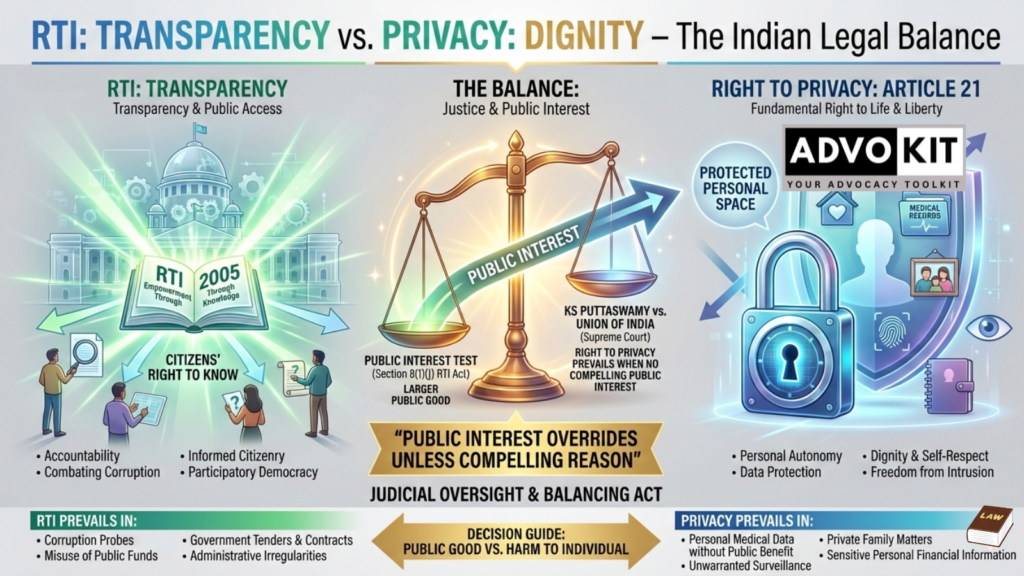
In India, the right to information promotes transparency and accountability in governance, while the right to privacy safeguards personal autonomy and dignity. These fundamental rights, both enshrined in the Constitution, often clash when public access to personal data held by authorities is sought. Judicial interpretations through landmark cases have been pivotal in delineating their boundaries and establishing a balancing mechanism.
Constitutional Foundations
The right to information derives from Article 19(1)(a), guaranteeing freedom of speech and expression, and was formalized through the Right to Information Act, 2005 (RTI Act). This empowers citizens to access records from public authorities, fostering democratic participation unless exemptions apply.
Conversely, the right to privacy emerged as a fundamental right under Article 21, protecting life and personal liberty. Initially contested in cases like M.P. Sharma v. Satish Chandra (1954), where it was deemed outside public law, and Kharak Singh v. State of Uttar Pradesh (1963), which struck down domiciliary visits but denied its fundamental status, privacy gained firm recognition in Justice K.S. Puttaswamy v. Union of India (2017). The nine-judge bench unanimously held privacy intrinsic to Article 21, overruling prior narrow views and introducing the proportionality test for restrictions.
Core Conflict Explored
The RTI Act’s Section 8(1)(j) exempts personal information from disclosure if it invades privacy without serving larger public interest. Yet, undefined terms like “personal information,” “unwarranted invasion,” and “public interest” fuel disputes, especially over public servants’ assets, tax returns, medical records, or performance evaluations.
Tensions arise as RTI demands openness—covering documents, emails, and data held by public bodies—while privacy resists exposure of intimate details like biometric data or health records in government custody. Public Information Officers (PIOs) often invoke exemptions imaginatively, penalizing non-disclosure harshly, yet risking privacy breaches. This paradox challenges democracy: transparency combats corruption, but unchecked access erodes individual dignity in a surveillance-prone digital era.
Landmark Cases Shaping the Balance
- Courts have clarified distinctions through precedents. In State of U.P. v. Raj Narain (1975), the Supreme Court elevated information as vital to democracy, laying RTI groundwork. S.P. Gupta v. Union of India (1981) affirmed citizens’ right to know public transactions.
- Girish Ramchandra Deshpande v. Central Information Commissioner (2012) denied access to a public servant’s service records, prioritizing privacy absent public interest. Conversely, in Canara Bank v. C.S. Shyamala (2012), disclosure of an employee’s penalty details was allowed due to public function linkage.
- KS Puttaswamy (2017) revolutionized the discourse, mandating proportionality: restrictions must pursue legitimate aims via least intrusive means. Recent amendments via the Digital Personal Data Protection Act, 2023, refine Section 8(1)(j), empowering PIOs to deny data absent legitimate interest, harmonizing RTI with privacy amid data proliferation.
Judicial Role in Delineation
Case laws distinguish RTI—focused on public accountability, exempting fiduciary or security-sensitive data—from privacy, protecting non-public personal spheres unless overridden by public good. Courts mandate case-by-case public interest overrides, rejecting blanket exemptions.
PUCL v. Union of India (1997) protected telephone privacy, deeming tapping violative of Article 21. Bombay High Court’s Saket Gokhale v. Union of India addressed wrongful RTI applicant data uploads, reinforcing privacy safeguards.
This jurisprudence ensures neither right is absolute; RTI yields to privacy for purely personal matters, but public roles trigger scrutiny. Evolving interpretations, post-Puttaswamy, integrate data protection, urging clearer guidelines.
Path Forward
Balancing requires proactive disclosures, defined exemptions, and robust PIO training. Complementary rather than adversarial, these rights bolster governance when harmonized—RTI exposes misuse, privacy prevents abuse. Ongoing reforms, like DPDP Act integration, promise equilibrium, vital for India’s digital democracy.
Challenges like undefined exemptions, PIO disputes, and digital privacy breaches demand careful navigation, particularly for public servants’ sensitive data. Fresh entrants and citizens alike require handholding from experienced legal mentors to evaluate public interest overrides effectively. Pathways forward hinge on mentorship from seasoned professionals, offering guidance through proactive disclosures, robust PIO training, and DPDP Act compliance—ensuring balanced rights via expert-led strategies that foster compliance and prevent misuse in India’s evolving digital democracy.
You May Also Like

-
May 10, 2026
ABSTRACT: The persistent conflict between hate speech and freedom of speech is not new. Freedom of speech is the cornerstone of...

-
Mar 27, 2026
ABSTRACT This article examines the life of Shri Ram as a paradigm of ethical governance, Rajdharma, and constitutional morality. It...

-
Mar 17, 2026
Most Law Students Want to Work in Corporate Law. But Very Few Know What Corporate Lawyers Actually Do. Every year,...

-
Mar 16, 2026
I first heard the Latin phrase “volenti non fit injuria” in my Tort Law class, and honestly, it sounded intimidating....
Get in touch
Call us
+91 7309 606 226
info@advokit.co.in
Address
1, Sapru Marg, 2nd floor above Mr Brown, Hazratganj, Lucknow, Uttar Pradesh - 226001