
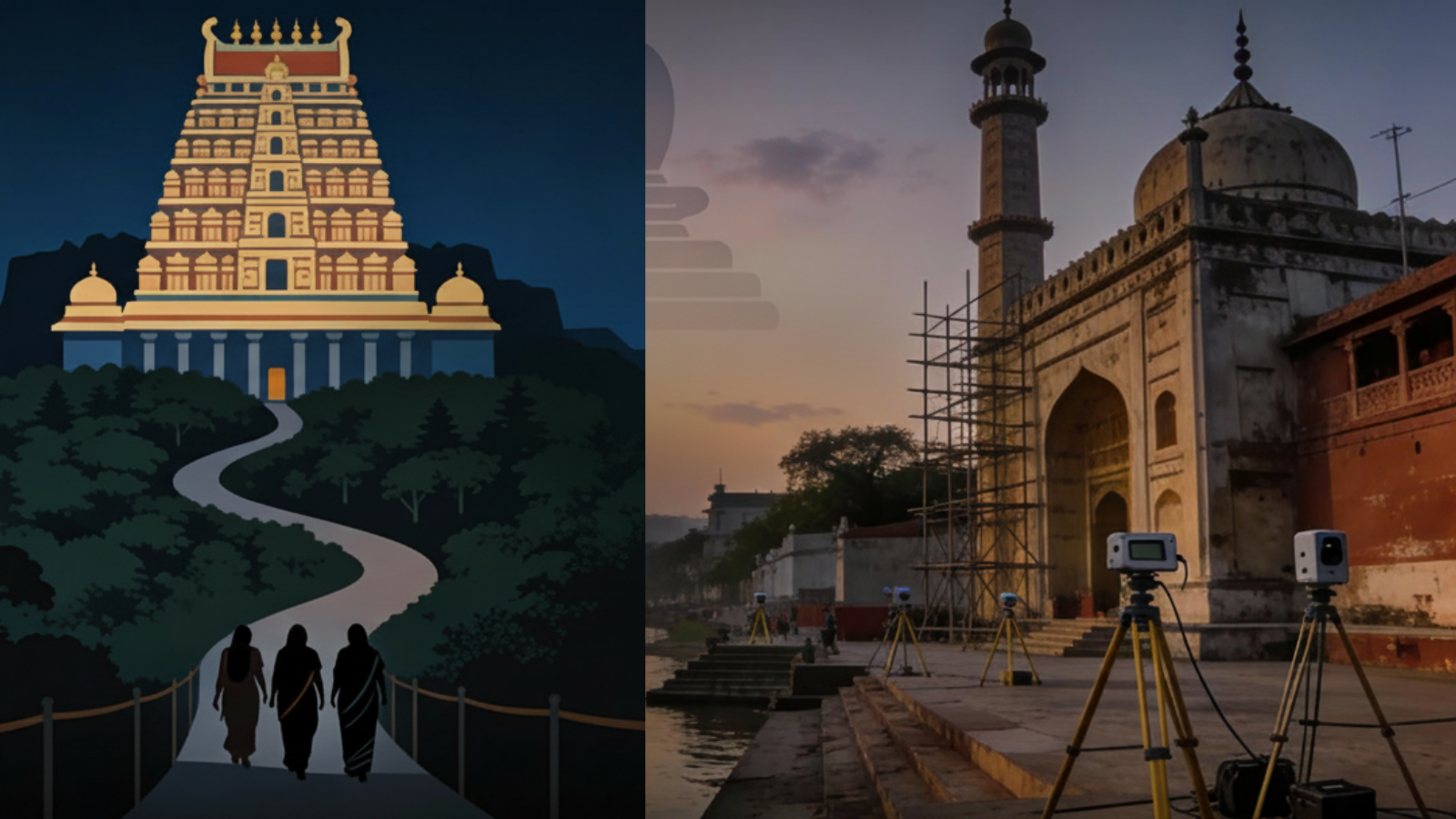
Imagine a temple that has prohibited women for generations; it may be defended as a sacred custom one day, but it may be declared discriminatory the next. Conversely, when a mosque is accused of concealing idols, courts suddenly mandate surveys in violation of rules that maintain the status quo regarding religion. Welcome to selective ERP application India, where the Essential Religious Practices (ERP) test under Articles 25–26 swings wildly between Gyanvapi’s mosque vs. temple debate and Sabarimala’s celibacy vow, igniting ten-year conflicts that reveal judicial inconsistencies.
India’s ERP doctrine controversies The Supreme Court began innocently enough with Shirur Mutt case (1954), holding that courts could only intervene in “secular” management and not in “essential” religious matters. However, in the midst of 5 crore pending cases, Sabarimala Gyanvapi selective ERP exposes how this play favourites, safeguarding the practices of one faith while investigating the roots of another.
Women Out as “Essential Practice” in the Sabarimala Verdict
2018 saw the explosion of Sabarimala: According to the “celibate vow” of the Ayyappa deity, women are prohibited for ten to fifty years (naisthik brahmachari). The ERP test Sabarimala was applied by a 4:1 majority; no ancient writings required exclusion, making it unlawful under right to equality. Indu Malhotra and other dissenting defended denomination rights, but CJI Misra emphasized constitutional morality. Women’s access has halted, the temple board is persistent, and review petitions are still pending.
However, ERP overruled a 1,400-year tradition by closely examining Hindu tantra. India’s selective religious intervention has drawn criticism. Why are Hindu “essentials” being investigated so vigorously?
Gyanvapi Flip: Mosque Survey Despite 1991 Act Freeze
Hindus say Aurangzeb destroyed the Vishweshwar temple on top of this 17th-century mosque next to Kashi Vishwanath. In 2021 a lawsuit under the 1991 Places of Worship Act (post-1947 status quo); nonetheless, the Varanasi court mandates the ASI survey (2023); the Supreme Court delays portions but permits worship claims. Was Shivling discovered in the Wazukhana? Despite protests, the Puja continues in the premises.
Selective flaring in the Gyanvapi ERP application: The “essential” nature of the mosque is not tested by ERP; instead, it is treated as disputed archaeology. The 1991 Act was intended to put an end to Babri-style conflicts, but Gyanvapi’s endless legal battles continue through ASI digs, which the Allahabad High Court approves.
Courts carefully examine whether rituals are “essential religious practices,” frequently superseding long-standing norms, in cases like Sabarimala and the ongoing Triple Talaq disputes. ERP is completely circumvented in the Gyanvapi and Mathura conflicts; no court inquires as to whether continuous namaz is an “essential mosque activity.” Instead, historical title claims and ASI surveys predominate, avoiding the faith-based safeguards Hindu cases have.
Legal Wars Drag: The Decade Long standoff
A frustrating tale of never-ending litigation ping-pong may be found in the Sabarimala Gyanvapi comparative legal fights. After the 2018 ruling permitting women to enter Sabarimala, there were review petitions, a presidential reference, and years later, the temple board was still preventing actual access. This chaos is mirrored in Gyanvapi, where a 2021 lawsuit leads to ASI assessments, partial stays by the Supreme Court, sealed reports, and new requests for excavation—all while the 1991 Places of Worship Act was intended to put an end to these issues. What began as “worship rights” cases (such as Shringar Gauri) now expands into parallel lawsuits, transforming India’s selective ERP endless litigation into a legal maze that chokes courts and exacerbates social divisions.
Path Forward: Time for Uniform ERP or Let It Rest?
Reforming ERP tests- This selective application has transformed holy places into ongoing courts, and India can’t wait any longer. Either strict uniformity, where courts examine all claims equally (mosque origins as carefully as temple vows), or Justice Malhotra’s dissenting wisdom—judge sincerely held views rather than ancient texts through contemporary lenses—are required for the future. Either bury the doctrine completely or standardize it across religions—Sabrimala-Gyanvapi demonstrates how selective ERP endless litigation in India undermines trust more quickly than it provides justice.
ERP that is specific Our loudest warning is Sabrimala-Gyanvapi: religious places continue to be battlegrounds where faith is subordinated to endless filings in the absence of set regulations. Courts have an obligation to treat all faiths with equal scrutiny, or constraint, in a democracy that promises unity under Articles 25–26. Then and only then will these legal conflicts give way to worship.
You May Also Like

-
May 10, 2026
ABSTRACT: The persistent conflict between hate speech and freedom of speech is not new. Freedom of speech is the cornerstone of...
-
Mar 27, 2026
ABSTRACT This article examines the life of Shri Ram as a paradigm of ethical governance, Rajdharma, and constitutional morality. It...

-
Mar 17, 2026
Most Law Students Want to Work in Corporate Law. But Very Few Know What Corporate Lawyers Actually Do. Every year,...

-
Mar 16, 2026
I first heard the Latin phrase “volenti non fit injuria” in my Tort Law class, and honestly, it sounded intimidating....
Get in touch
Call us
+91 7309 606 226
info@advokit.co.in
Address
1, Sapru Marg, 2nd floor above Mr Brown, Hazratganj, Lucknow, Uttar Pradesh - 226001